

One of the defining moments in the career of an investor is when they shed their misunderstanding of “risk” as “the likelihood of losing money” and replace that definition with “unforeseeable movements in price”. We commonly equate the “risk” of an investment with its standard deviation (as volatility), which offers us a useful insight into the return profile of the asset; i.e how much the sequence of investment returns move around over a period of time, and how far away they move from the asset’s most “common” return based on its past performance.

Two of the largest criticisms of standard deviation as risk
1) That it is not forward looking; i.e it is based entirely upon historical performance data, of which there is no guarantee of repetition in the future. Of course, most assets, particularly passive investments or trackers, do not tend to deviate from their historic performance profile by a great degree. However, active investments (e.g. actively managed funds) show a much larger scope for variance owing to their ability to change their investment strategy at the discretion of their managers.
2) Standard deviation as a performance metric does not differentiate between upward and downward variance. i.e if an asset shows meteoric growth during a year, it would show a high SD reading, as would an asset which moved down and made large losses that year. Accordingly, without context, standard deviation could lead to some dangerous misunderstandings and the wrongful inclusion of an asset in an investment portfolio.
Key Determinants Of Risk: Position Sizing
The standard deviation of an asset is secondary to position sizing in the context of risk. This is a key concept. In isolation, standard deviation alone does not allow us to make any inference about portfolio risk. If we have two assets, asset A and asset B, and the first has a standard deviation of 15% over a calendar year, and asset B has a standard deviation of 30% over a calendar year, you could be forgiven for making the statement that “asset B is more risky than asset A”. This statement would be correct, but only half the story if both investments are constituents of a portfolio- we can make no inference as to their overall risk contribution to the portfolio unless we understand their weighting in the portfolio. If we work on the premise that both asset A and asset B have a perfect correlation with each other (i.e they move up and down in tandem) then when our allocation to asset A is half of the size of our allocation to asset B, despite their differing levels of volatility, they contribute an equal amount of risk to the portfolio.
Key Determinants Of Risk: Correlation Management

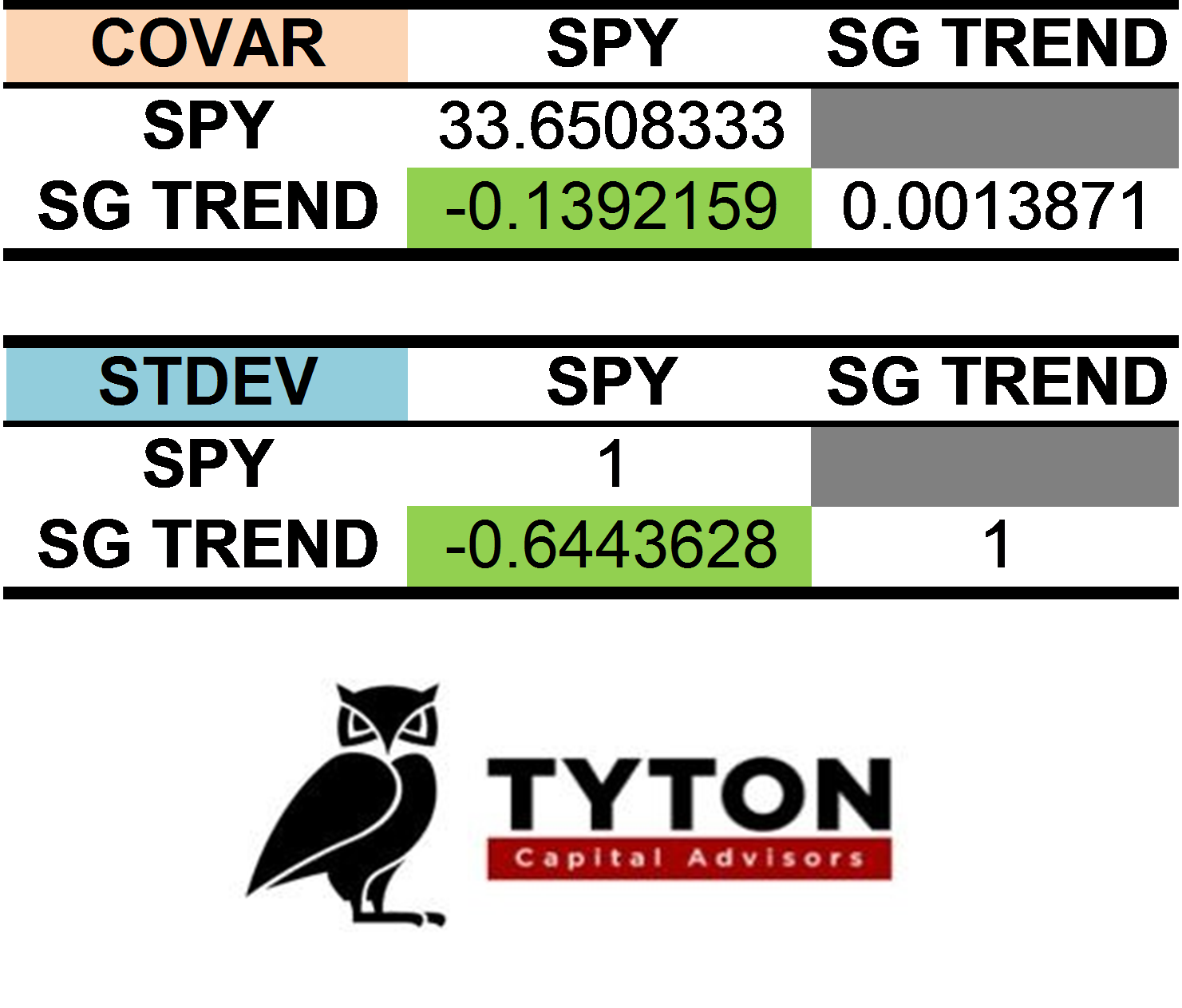
The measure used to indicate the extent to which two random variables change in tandem is known as covariance.
The measure used to represent how strongly two random variables are related known as correlation.
Correlation is dimensionless, i.e. it is a unit-free measure of the relationship between variables (in this case, the returns of the two assets). Unlike co-variance, where the value is obtained by the product of the units of the two variables. Conclusively, a +1 reading denotes a perfect positive correlation (assets move up and down together in lockstep) and a -1 reading denotes a perfect negative correlation (assets move in opposite directions). Failure to consider correlation between portfolio assets could undermine the portfolio construction process, increase non-systematic risk, and reduce returns.
Standard Deviation In A Meaningful Context: An S&P500 Case Study
Nowhere is correlation as meaningful as in a market crash or correction scenario. Increasingly, correlation between asset classes can be seen to move towards +1 in periods of stress, but there are still methods to reduce drawdowns during outlier events. The go-to for professional investors will be the inclusion of alternative investments of absolute return strategies which thematically have low-to-no correlation to traditional asset classes.
Let us consider the impact of having included an allocation to managed futures strategies, or CTA‘s during the global financial crisis. To what extent would it have mitigated losses in an equity portfolio, and what is the overall effect of correlation management on portfolio risk?
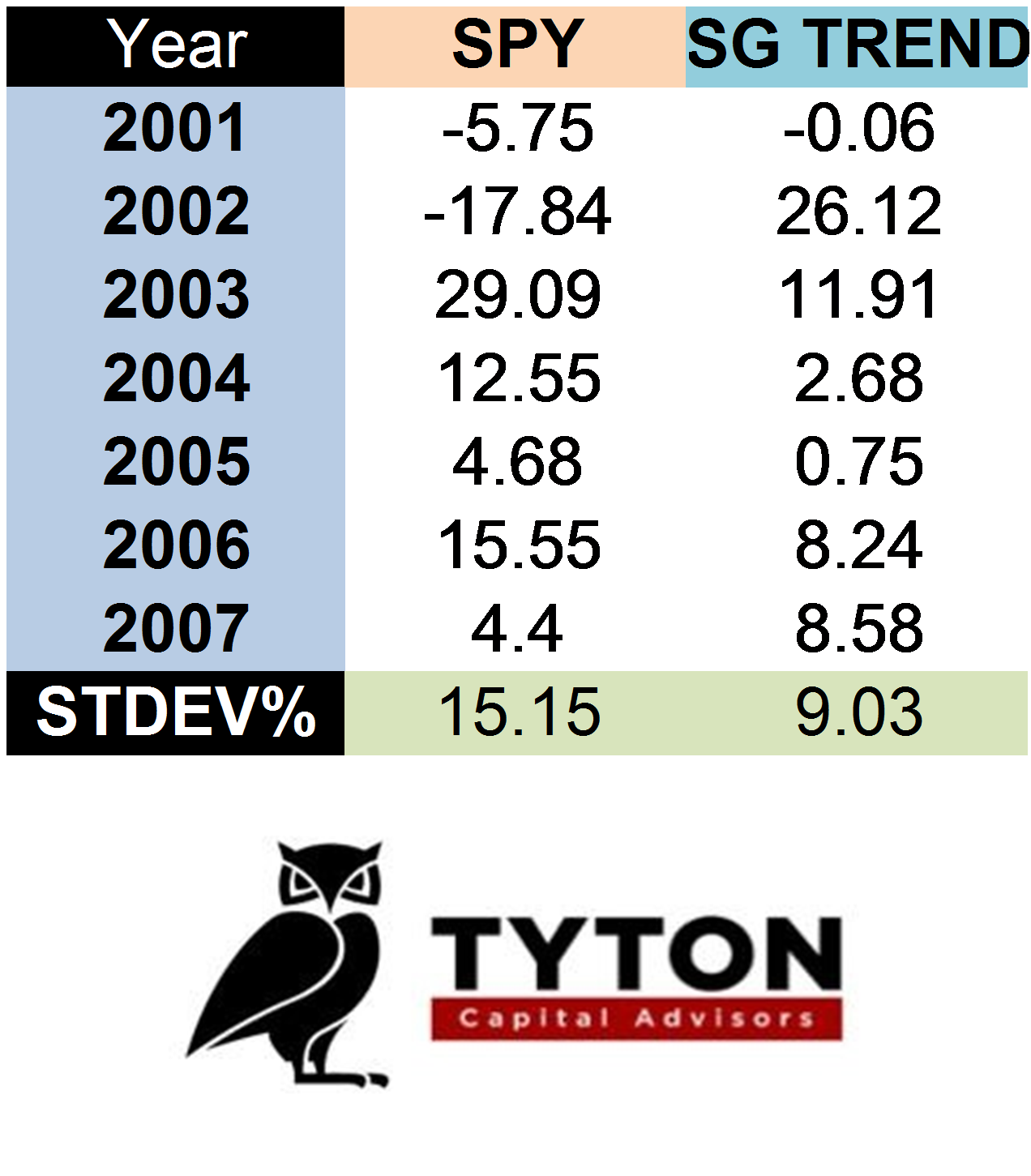
For the sake of keeping things simple, we shall use the Societe Generale Trend Index ( CTA funds or Commodity Trading Advisors) for our allocation to absolute return strategies. The Index is designed to track the 10 largest (by AUM) trend following CTAs and be seen as representative of the trend-followers in the managed futures space. Managed futures strategies historically provide a significant diversification effect to traditional portfolios.
For our equity investment, we shall use the SPDR S&P500 index tracker (NYSE:SPY). The ETF tracks the investment performance of the 500 companies composing the S&P500 index- historically used as a barometer for the US stock market.



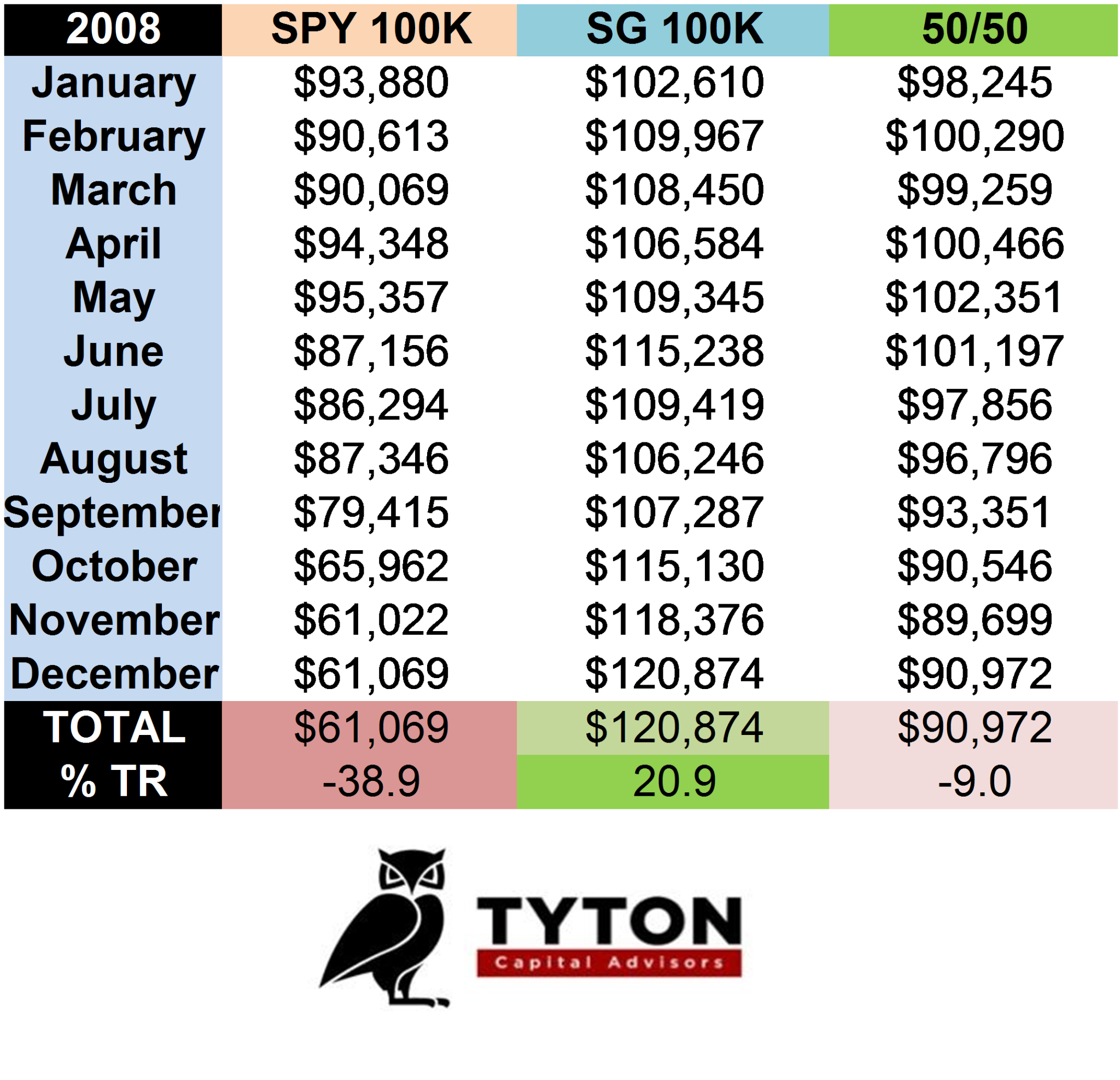
We can see from the table that a 100,000 USD investment into the S&P500 index tracker at the beginning of 2008 would have drawn down to 61,069 USD, producing a total loss of -38.9%, a 100% allocation to the SG Trend index would have grown 20.9% to 120,874 USD and a 50/50 allocation to both assets would have drawn down to 90,972 USD with a total return of -9%.
Some may say, “well why not invest all the money into the SG Trend Index?”, to which the answer would be – diversification. The real conclusion is in the ability of alternative investments (and correlation management among assets in general) to reduce portfolio risk. By spreading their portfolio across two assets instead of one, and investor could have avoided 77% of the drawdown experienced by index investors in the global financial crisis. Now, in reality, it is impossible to simply buy the SG Trend index in the same way that somebody might buy NYSE:SPY. Far from making this exercise a moot point, it should go to show that correlation management is an active, not passive exercise and that the deliberate reduction of portfolio risk should occur before investments are made.