Admittedly, portfolio management can be complex. That however does not mean that you have to be a professional to make your own investment portfolio and invest on your own. Seeing as over two thirds of portfolio performance is attributable to the allocation among asset classes, rather than individual asset performance you will benefit from understanding how to allocate cash among a group of assets appropriately. Now, once you have determined which asset classes to allocate to, the following selection of specific instruments from each category and the amount to be purchased, the road opens up and becomes more mathematics based and more theoretical (as there is no one-size-fits-all approach to making profitable investments). The following system will get you to the first stage, enabling you to construct an appropriate portfolio for your own risk appetite. Once you have your asset allocations determined then you can optimise thereafter as you strengthen your understanding of investment portfolio construction methodologies.
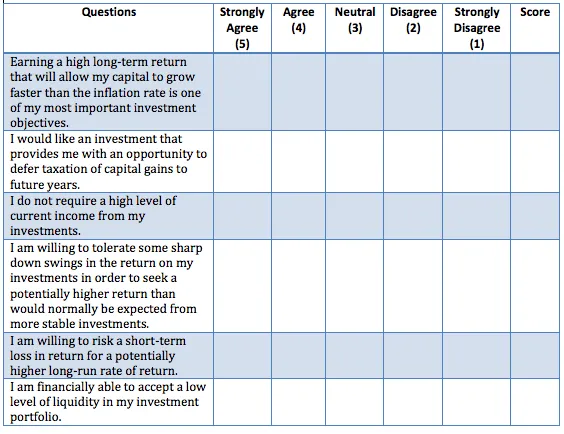
Sometimes referred to as PASS, the “global portfolio allocation scoring system” is a short behavioral exercise that will provide each investor with a number score. Each score will correspond to a level of risk and each level of risk has a recommended portfolio with varying allocations to each asset class. When faced with questions like, “what kind of investor are you?” or “what is your attitude toward risk?” 99% of people will be unable to answer in a way that is actionable. The PASS system translates feelings, experiences and dispositions into a corresponding, quantitative portfolio template.
Considering the simplicity of the method it should not come as a surprise that there are limitations. Indeed, there is doubtful a single professional investment portfolio manager in the world who’s allocation methodology looks like the above. The system aims to provide guidelines for a safe balance of investments, based on an individual’s appetite for risk. There is no talk or consideration of which assets to select in each class, of correlation, of tax efficiency, of liquidity management or goal planning. Once you have your own small DIY portfolio you will gain a practical understanding of basic investment management; the only cost will be your time. If you have substantial assets, or feel out of your depth, then it may be a good idea to seek the guidance of a financial advisor or investment planner to ensure that you are not putting your capital at risk.